
Motivosity's own research found fewer than 2% of Inc. 5000 CEOs review their engagement survey results more than once — and in 2026, only 23% of U.S. employees report being engaged. The gap between running a survey and acting on it is where culture actually erodes.
Key takeaways:
Every year, millions of employees fill out an annual engagement survey. Most of that data never turns into a decision.
In a survey Motivosity ran of Inc. 5000 CEOs, fewer than 2% said they looked at their engagement survey results more than once. That number hasn't aged well — it's arguably gotten worse. As of early 2026, only 23% of U.S. employees report being engaged at work, and Gallup ties roughly 70% of the variance in team engagement directly to the manager, not the survey tool. The data keeps getting better. What leaders do with it hasn't caught up.
"Most CEOs don't understand the importance of culture," says Scott Johnson, Founder and CEO of Motivosity. "If they did, they wouldn't outsource it to HR."
Johnson has been on both sides of this. Early in his career running a fast-growing company with nearly 500 employees, he assumed that winning as a business would naturally translate into people loving where they worked.
"Like a lot of CEOs, I used to think people would be happier if the business was winning. So I focused on winning and hoped the rest would follow. We made the Inc. 5000 list, but I'm convinced we could have gotten there faster and with a lot less pain if we'd managed engagement programmatically instead of hoping it would sort itself out."
Roughly 70% of CEOs on the Inc. 5000 list hand culture entirely to HR — understandable, since HR owns the programs, but a mistake when leadership treats that as license to stop paying attention. Culture problems rarely show up as a single bad metric. They show up as the senior engineer who stops raising ideas in meetings, the branch that can't keep a manager past 18 months, or the exit interview that says "lack of growth" for the fourth quarter running.
None of that requires a new survey vendor. It requires someone at the top treating engagement data the way they'd treat a revenue miss — asking why, more than once, until the answer stops being vague.
The specific numbers move year to year, but the pattern hasn't: engagement is falling, and the gap between what employees want and what they get keeps widening. Only 36% of employees currently report feeling engaged, and just 24% feel psychologically safe enough at work to speak up when something's wrong, according to Achievers Workforce Institute's 2025 research. On the cost side, Gallup estimates low engagement drains roughly $8.9 trillion from the global economy each year — about 9% of global GDP.
Those aren't abstractions. They're the compounding cost of surveys that get sent, collected, and quietly filed away.
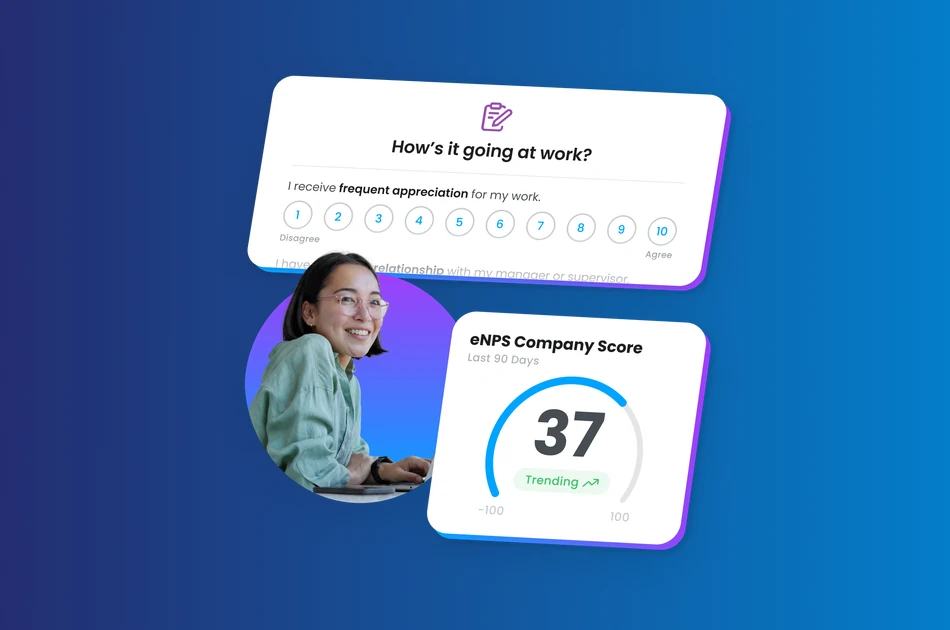
The fix isn't a better once-a-year survey. It's treating engagement like a metric you check as often as revenue or pipeline — through pulse surveys and eNPS tracking that surface problems while they're still small, paired with recognition data that shows you which teams are actually feeling the difference.
"I want every company to become a place people are genuinely glad to work," Johnson says. "That means treating culture as a system you manage on purpose, not a mood you hope for."